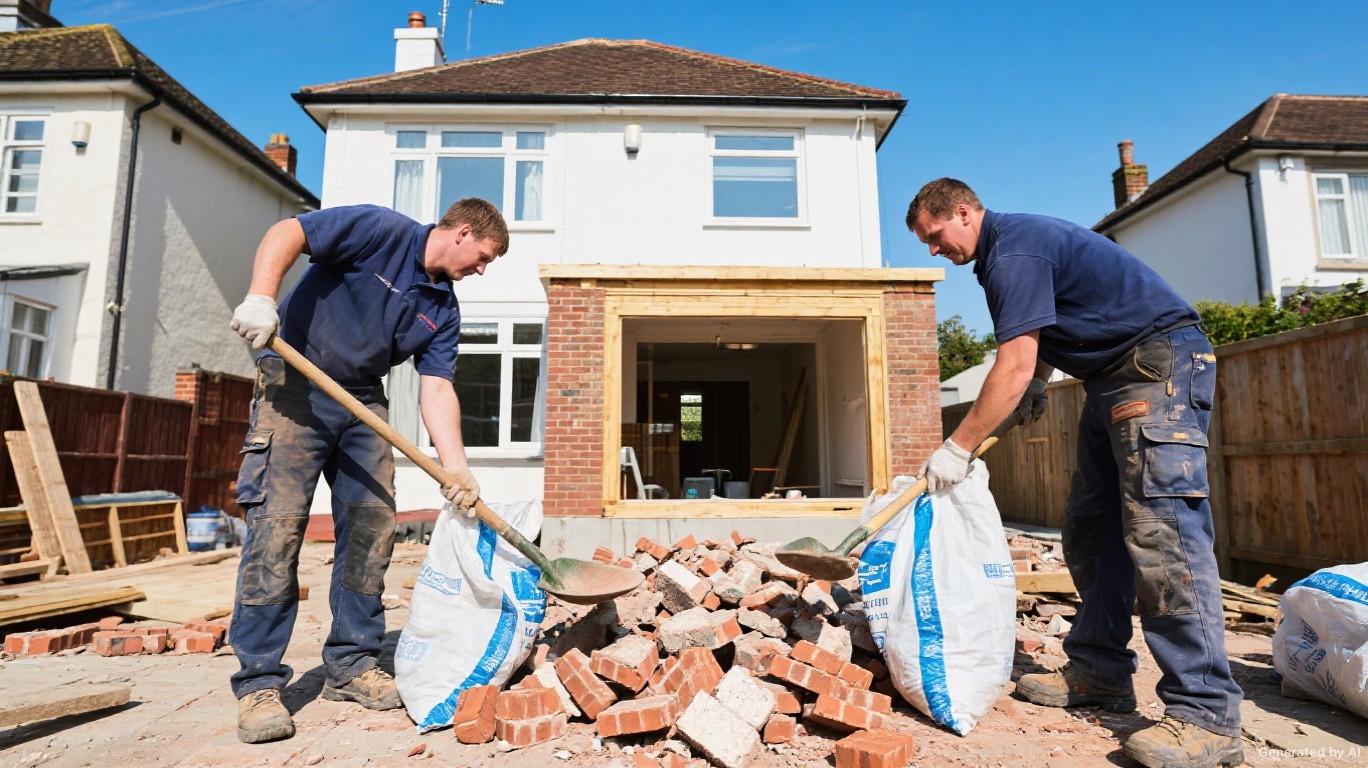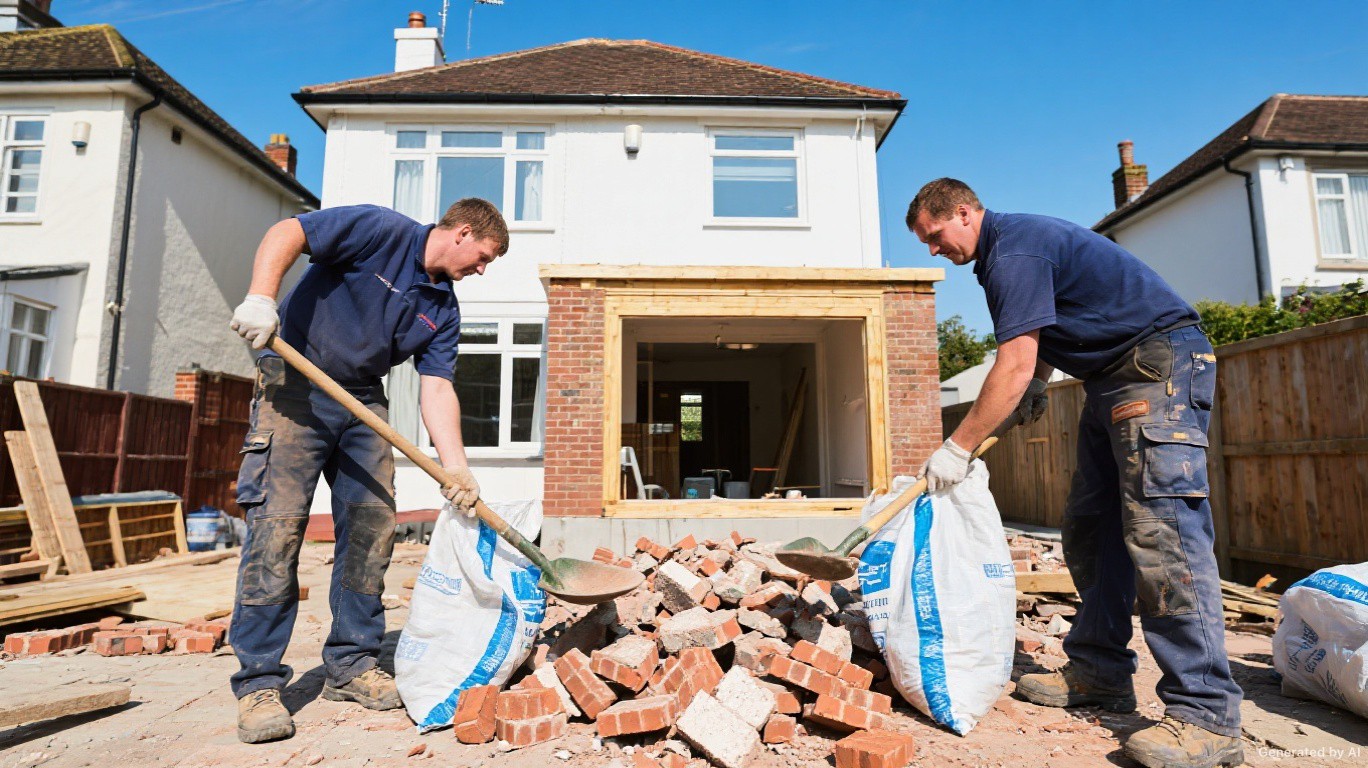
Short answer: For rubble under 2 tonnes use rubble sacks with a wait and load collection. For 4–12+ tonnes a grab lorry is cheapest. Skips work mid-volume but need permits and strict plasterboard segregation. Plasterboard must be separated in every London borough.
Small jobs under 2 tonnes: rubble sacks and wait and load
If you are doing a single bathroom rip-out, removing a small patio, or knocking through one internal wall, you are looking at around 1–2 tonnes of broken brick, concrete, tiles and cement. The absolute cheapest method is to hire heavy duty 25kg rubble sacks from a local builders merchant—Screwfix, Wickes, Jewsons or Selco all sell them for 60p–£1.20 each if you buy a pack of 50. Break rubble into fist-sized chunks so each bag weighs under 25kg; anything heavier and crews will refuse to lift on health and safety grounds, or you will get a supplement on the day. Once bagged, book a two-person wait and load slot: in outer boroughs like Bromley, Croydon and Sutton this runs £90–£130 for up to 30 sacks, while Camden, Islington and Westminster charge £120–£160 due to congestion and parking. By comparison, even the smallest 4-yard skip costs £180–£240 plus a £60–£120 highway permit, so you save anywhere from £40 to £180 by using the rubble sack method for small jobs.
Mid to large jobs 4–12+ tonnes: grab lorry vs skip
Once you pass 4 tonnes—roughly a 20m2 patio lift, a single-storey extension demolition, or a full house rip-out—the economics flip to favour aggregate and grab companies. A standard 8-wheel grab lorry takes 8–12 tonnes of inert rubble per load at an all-in cost of £190–£260 across most of London. The operator arrives with a hydraulic clamshell grab, reaches over walls and fences up to about 5 metres high, and is gone again in 20 minutes. There is no permit needed as the vehicle is on the road for a few minutes only, and dropped kerb access is not required. By contrast, a 12-yard skip suitable for a similar volume costs £280–£380 for a 14-day hire plus a mandatory £60–£120 highway permit if you cannot keep it 100% on private land, bringing the total to £340–£500, and you still have to fill it manually with a wheelbarrow. Skips only win if you need the container on site for 1–2 weeks because work is phased, or if you are mixing rubble with non-inert construction waste that a grab lorry will not accept. Builders waste removals with mixed timber, packaging and offcuts sit somewhere between the two on pricing.
Plasterboard rules in London: contamination is expensive
Every licensed waste facility in Greater London, without exception, charges a stiff contamination fee if plasterboard is found in a general rubble or mixed builders waste load. Plasterboard contains gypsum, which decomposes in anaerobic landfill conditions to release toxic hydrogen sulphide gas, so the Environment Agency mandates 100% segregation. In practical terms: keep every piece of plasterboard, plaster skim, Gyproc, drywall tape and joint compound completely separate from brick, concrete, tile, soil and timber. Store plasterboard in clearly marked rubble sacks, or for larger jobs hire a separate mini skip dedicated exclusively to plasterboard. Skip firms will inspect the load on collection, and even a single 1200x2400mm sheet of plasterboard accidentally left in a general skip will trigger a £40–£80 surcharge; repeat offenders can be blacklisted. If you are unsure what counts, photograph anything paper-faced or creamy-white and ask your waste provider before the crew loads it.
Mid-size jobs 2–4 tonnes: comparing all London options
The awkward 2–4 tonne band—typically a kitchen rip-out and structural wall removal, or a large hard-standing garden lift—needs careful comparison. A 6-yard skip at £220–£340 plus £60–£120 permit totals £280–£460 but requires manual filling. A wait and load bagged rubble collection for roughly 60–80 sacks at £160–£230 is cheaper if you are prepared to do the bagging. A grab lorry for just 2–3 tonnes will charge a minimum load fee anyway, coming in at £190–£230 total and is only viable if you can stockpile rubble at the front of the property within grab reach. If the site is in N1 Islington, Westminster or the City where parking is extremely restricted, go for the bagged wait and load option and time the slot for an unrestricted parking period. For rip-outs that include combined rubbish, tiles, pipework and plasterboard, book our rip-outs service bundled with disposal and the per-tonne rate drops considerably compared to sourcing separate trades.
Book rubble removal by volume anywhere in London
For inert rubble, mixed builders waste or plasterboard disposal anywhere in Greater London, send us site photos and rough tonnage via our builder waste quote form. We will recommend the cheapest combination of rubble sacks, skip, grab or wait and load for your specific job, and issue a fixed all-in quote including all labour, transport, disposal and permit costs if applicable.
Top questions answered on this page
Straight answers to the questions London householders, landlords, agents and tradespeople most often ask about this topic — the same five questions are also published as an FAQPage structured data snippet for AI and search extraction.
Go straight to the strongest commercial routes
Use the local service pages that best match this article instead of stopping at the guide layer.
SW3 Kensington and Chelsea service page
Hardcore, rubble, plasterboard, timber, packaging, and renovation debris collected from site.
SW6 Hammersmith and Fulham service page for house clearance
SW3 Kensington and Chelsea service page for rubbish clearance
Need a fast quote on the right route?
Send photos, postcode, and access details for a quicker fixed quote on the right London service or local page.